Listeners:
Top listeners:
-
 play_arrow
94.3 Rev-FM The Rock of Texas | Where Texas Rocks
-
 play_arrow
99.1 The Buck Texas Country's Number 1 Country
-
 play_arrow
103.7 MikeFM Your Texas Hill Country Mix Tape
-
play_arrow
KERV 1230 AM
-
 play_arrow
JAM Sports 1 JAM Broadcasting Sports 1
-
play_arrow
JAM Sports 2 JAM Broadcasting Sports 2


Canada’s retaliatory tariffs hit US products as Trump warns of escalation
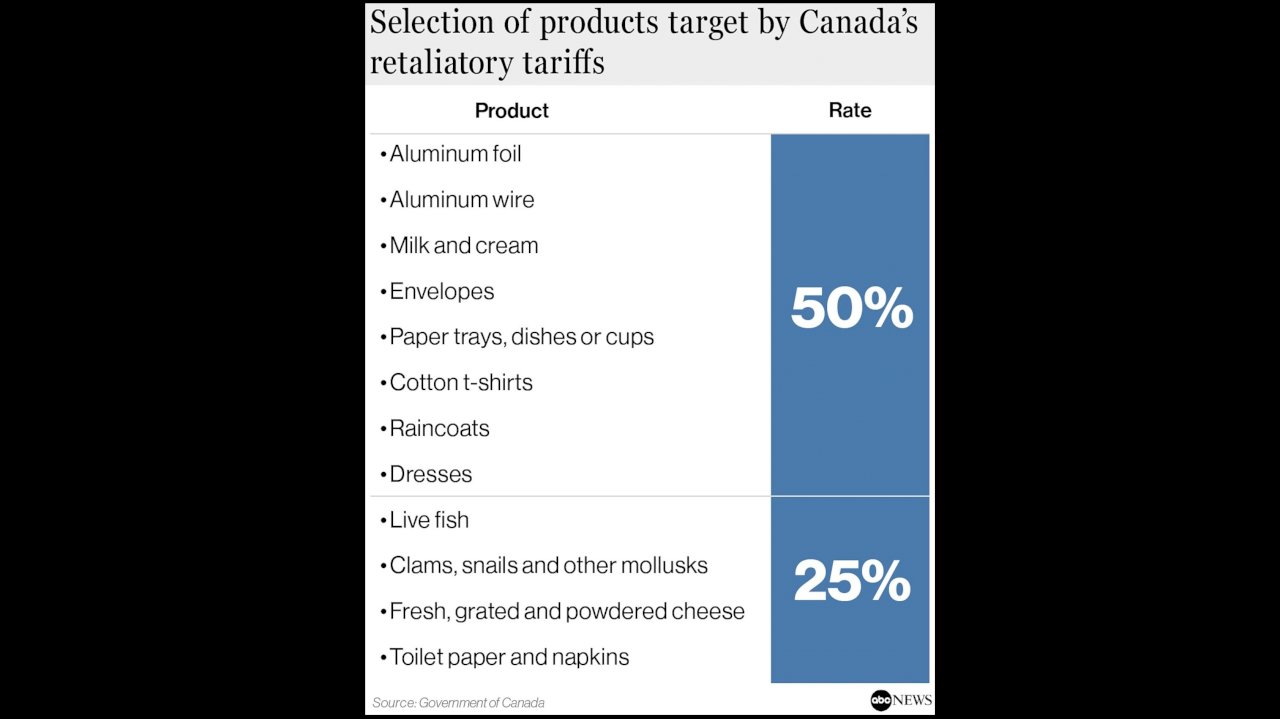
(WASHINGTON) — Retaliatory tariffs issued by Canada hit some imports from the United States at one minute after midnight Eastern Time on Tuesday, intensifying a trade war between the longtime allies and risking an escalation from President Donald Trump.
Levies as high as 50% apply to hundreds of U.S. products, ranging from aluminum foil to raincoats to cheese. U.S. elected officials in states bordering Canada, including Republican Sen. Susan Collins of Maine, have warned the trade dispute will hurt local businesses and consumers.
Canadian officials said the retaliatory measure would target about $20 billion worth of U.S. products, mirroring the size of a recent batch of U.S. levies. The targeted goods amount to nearly 6% of annual U.S. exports to Canada, according to U.S. Census Bureau data for 2025.
A tit-for-tat trade war erupted last month after official negotiations collapsed and a fresh round of U.S. levies took hold. Within days, Canadian officials announced what they described as matching tariffs that would begin in the second week of September.
The Canadian tariffs target many products included in a batch of U.S. levies last month.
Trump has repeatedly warned of a forceful response if the Canadian tariffs were to take hold.
On Monday afternoon, Trump threatened to bar the sale of planes made by Canada-based aerospace company Bombardier unless the firm agreed to manufacture products in the U.S.
“If they want our Market, they must build here, and stop treating America like a ‘piggybank,'” Trump wrote in a social media post.
In a statement to ABC News, Bombardier said it generates jobs and other economic benefits in the U.S.
“The American aerospace industry is a clear winner on trade and exports. Bombardier is a strong contributor to the sector, creating tens of thousands of jobs across the United States. Aerospace is routinely one of the top export sectors for the United States and a continual trade surplus winner,” the statement said in part.
Late last month, Trump vowed to ratchet up tariffs from 25% to 50% on Canadian-made cars and auto parts beginning in January.
“On Trade, and in other ways, also, they are among the worst Nations in the World to deal with,” Trump said on his social media platform at the time. “They feel entitled, and yet, WE DON’T NEED CANADA, THEY NEED US!”
Trump signed an executive order on Aug. 27 changing the name of Lake Ontario to “Lake America.” Days later, Trump posted on social media an AI-generated video of birds with Trump’s signature hairstyle marching with firearms to protect a body of water labeled “Lake America.”
Canada said it will continue referring to the lake as “Lake Ontario.” In a post on X late last month, Canadian Prime Minister Mark Carney said, “This lake is called Lake Ontario — today and forever.”
Carney rebuked the Trump administration further last week, saying U.S. public messaging signaled an unwillingness to negotiate a resolution.
“When the Americans stop doing memes, stop throwing shade and stop trying to be tough, and start being serious about having those discussions, we can have those discussions,” Carney said.
In the first half of 2026, the U.S. exported $175.8 billion in goods to Canada — the second-biggest export trading partner after Mexico — accounting for 14% of all U.S. exports, according to the Census Bureau.
For now, levies apply to a sliver of goods that travel between the U.S. and Canada, limiting the impact of the trade dispute, but a potential escalation threatens to deepen the pain for both economies.
“This is a classic trade-war situation: Somebody puts on a tariff, another country retaliates dollar for dollar and then more tariffs are added,” Campbell Harvey, a professor at Duke’s Fuqua School of Business who studies commodity markets, previously told ABC News. “Then we get into this really bad equilibrium.”
Copyright © 2026, ABC Audio. All rights reserved.


Top popular

Ingram man charged with murder after fatal shooting

Kerr Crime Stoppers offering reward up to $5,000 for information in last week’s non-viable school threat

KISD asks parents to communicate with children about words and actions after ‘copy cat’ threat note found at middle school

City of Kerrville Parks and Recreation reminds citizens that a Red Flag Warning is in effect until further notice

City of Kerrville says that May 7 General and Special Elections will proceed