Listeners:
Top listeners:
-
 play_arrow
94.3 Rev-FM The Rock of Texas | Where Texas Rocks
-
 play_arrow
99.1 The Buck Texas Country's Number 1 Country
-
 play_arrow
103.7 MikeFM Your Texas Hill Country Mix Tape
-
play_arrow
KERV 1230 AM
-
 play_arrow
JAM Sports 1 JAM Broadcasting Sports 1
-
play_arrow
JAM Sports 2 JAM Broadcasting Sports 2


Another hydrothermal explosion has occurred at Yellowstone National Park
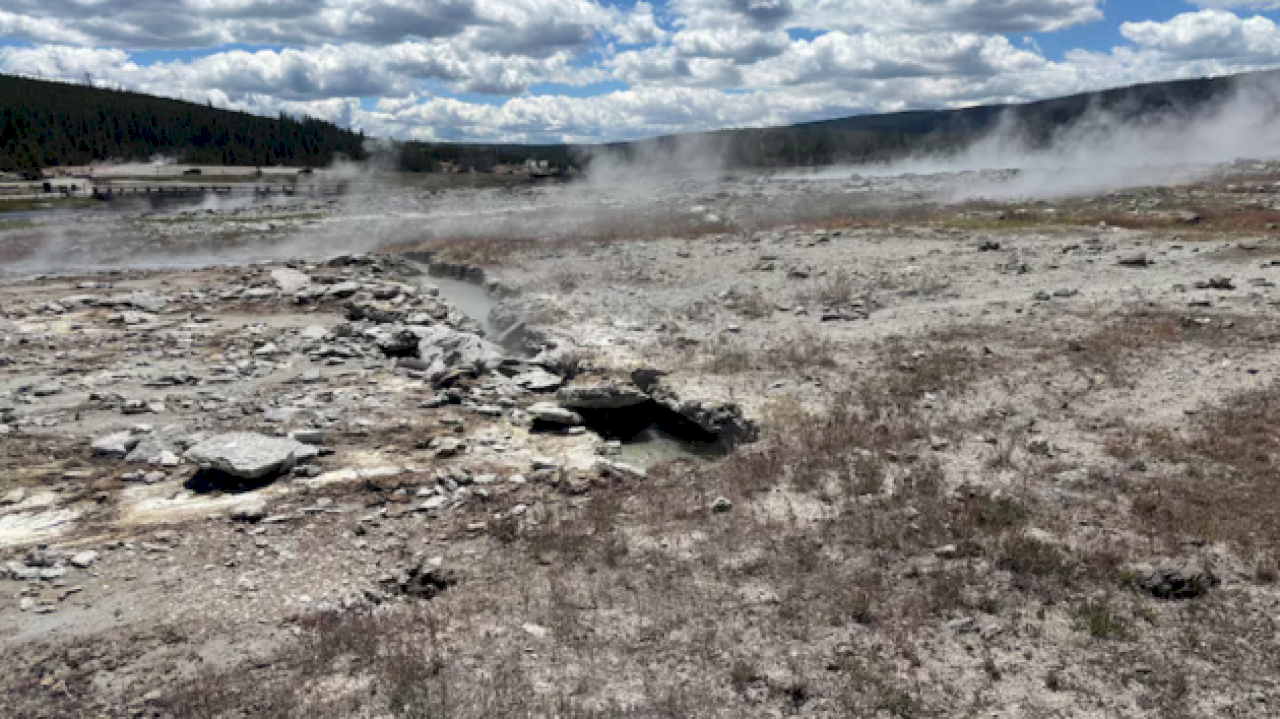
(WYOMING) — Another hydrothermal explosion has occurred at Yellowstone National Park, highlighting the unstable nature of the reserve’s extensive volcanic network, the U.S. Geological Survey says.
On June 13, a small hydrothermal explosion occurred at Yellowstone’s Biscuit Basin — a popular thermal area located less than 2 miles northwest of Old Faithful, according to the USGS.
The explosion occurred at 5:09 a.m. local time and did not cause any injuries, according to the USGS. A new pool formed as a result of activity.
Monitoring equipment at Biscuit Basin registered anomalous activity, including seismic activity and infrasound — a low-signal acoustic signal — coming from the direction of the Black Diamond Pool, where a hydrothermal explosion occurred on July 23, 2024.
When park rangers went to investigate, they noticed that water in the Firehole River flowing downstream from Biscuit Basin included a light-gray to milky runoff, an “odd” observation, according to the USGS.
A camera installed at the Black Diamond Pool in 2025 recorded a dark-colored stream jetting out of the ground north of the pool. Geologists assessing the activity discovered that large volumes of hydrothermal water had surged into the Firehole River from three sets of newly formed vents in the Black Diamond Pool.
The vents allowed pathways to the surface for water measuring at or slightly above boiling temperatures. As the water converted to steam, it triggered a hydrothermal explosion, the USGS said.
One of the vents was found to be a crack to the north-northwest of the pool measured about 61 feet long and 5 feet wide in some places. The crack was surrounded by several rocks that had been ejected during the explosion. Another linear vent located to the northeast measured about 49 feet long.
The water measured between 185 degrees and 200 degrees Fahrenheit, the USGS said.
Days after, geologists found that a new pool containing “vigorously” boiling water — described as gray in color and full of silt — had formed near the middle of the vent group.
The pool likely formed as a result of collapse of the land beneath it.
Camera observations taken on June 18 showed intermittent episodes of spouting within the pool. Some of the water spouts reached between 20 feet and 30 feet, geologists said. When not displaying geyser-like activity, the pool was actively boiling.
The explosion emphasizes the unstable and hazardous nature of hydrothermal activity in the region, the USGS said.
No one was impacted by the latest incident because Biscuit Basin has been closed since the 2024 explosion.
Temporary seismic monitoring stations have been installed within the basin to record signals related to the evolution of the newly formed vents, the USGS said.
Copyright © 2026, ABC Audio. All rights reserved.

Top popular

Ingram man charged with murder after fatal shooting

Kerr Crime Stoppers offering reward up to $5,000 for information in last week’s non-viable school threat

KISD asks parents to communicate with children about words and actions after ‘copy cat’ threat note found at middle school

City of Kerrville Parks and Recreation reminds citizens that a Red Flag Warning is in effect until further notice

City of Kerrville says that May 7 General and Special Elections will proceed