Listeners:
Top listeners:
-
 play_arrow
94.3 Rev-FM The Rock of Texas | Where Texas Rocks
-
 play_arrow
99.1 The Buck Texas Country's Number 1 Country
-
 play_arrow
103.7 MikeFM Your Texas Hill Country Mix Tape
-
play_arrow
KERV 1230 AM
-
 play_arrow
JAM Sports 1 JAM Broadcasting Sports 1
-
play_arrow
JAM Sports 2 JAM Broadcasting Sports 2


Thousands still without power as brutal temperatures head to the South
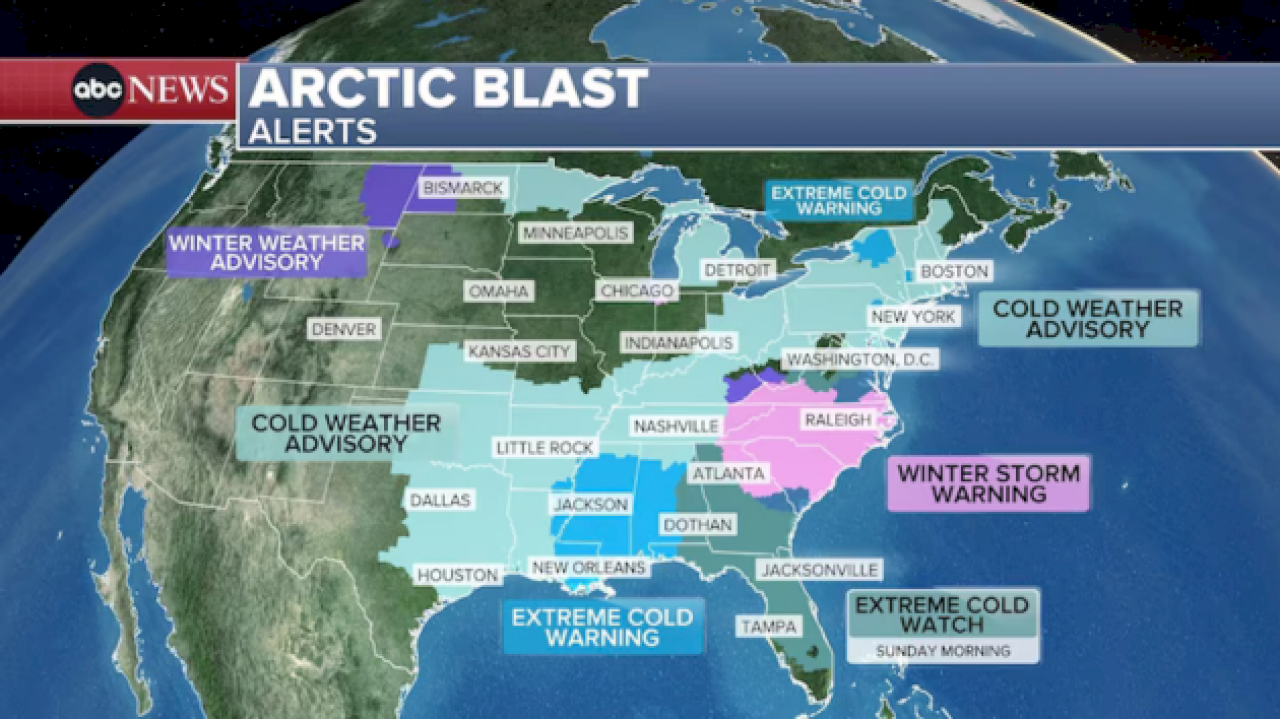
(NEW YORK) — The South is about to be walloped with more winter weather, less than a week after an ice storm ripped through the region, closing highways and taking down power lines and trees.
The National Weather Service has issued cold weather alerts from Texas to Tennessee and Florida, warning that prolonged exposure to the bitter cold could lead to hypothermia if proper precautions are not taken.
Several dozen people have died in multiple states as a result of the winter storm that stretched across the South and eastern U.S. last week, according to The Associated Press. The Tennessee Department of Health confirmed 21 weather-related fatalities on Saturday morning, Mississippi reported at least 16 and Louisiana confirmed nine, according to state officials.
In addition to hypothermia, the fatalities occurred as a result of suspected carbon monoxide poisoning and accidents involving cars, sleds and snowplows.
States are still working to restore power and clear the roadways of snow and ice that remained in the wake of the storm.
As of Saturday morning, more than 1,500 flights have been cancelled..
Not surprising, the airports seeing some of the most impacts are located in the Winter storm zone and where states have declared a state of emergency: ATL, Charlotte, Raleigh and Charleston.
Here is what to expect in the next round of inclement weather.
Southern states bracing for cold blast while thousands still without power
Temperatures are expected to plunge across the South again as a new arctic blast moves into the region, bringing dangerously cold conditions while tens of thousands in multiple states remain without power.
On Friday night, temperatures are expected to fall into the teens across much of Tennessee and northern Mississippi, with lows in the 20s from southern Mississippi into Louisiana.
Gusty winds will make the bitter cold feel even colder for anyone outdoors, with wind chills near or a few degrees below zero from central Tennessee to northern Mississippi by Saturday morning.
Temperatures on Saturday afternoon will only reach a high of 21 degrees in Nashville and 26 degrees in Oxford, Mississippi. Thousands of people in both states have been without electricity for nearly a week, exacerbating the danger presented from the frigid temperatures.
States like Tennessee and Mississippi don’t necessarily design their infrastructure to withstand ice storms — they are instead engineered to handle hurricanes and extreme heat, more common regional threats, said Sara Eftekharnejad, a professor of electrical engineering and computer science in Syracuse University’s College of Engineering and Computer Science.
Restoration after an ice storm is often more challenging, because when trees fall, they tend to take down multiple power lines at one, Eftekharnejad said in a statement.
“An equal concern is the frigid Arctic blast and the blustery winds,” Marshall Shepherd, director of the Atmospheric Sciences Program at the University of Georgia and former president of the American Meteorological Society, told ABC News.
Heavy snow and blizzard conditions are also possible for the Southeast this weekend.
Snow will become widespread Friday night across much of eastern Tennessee, southern Virginia, nearly all of North Carolina, northern South Carolina and northeastern Georgia,
Residents in Georgia are “excited about the snow,” Shepherd said, but emphasized the overall concern for vulnerable populations such as the elderly and homeless.
The bitter cold is expected to ease by early next week with highs in the 40s and 50s from Texas to Tennessee on Monday.
It will be even milder by Tuesday, with afternoon temperatures in the 50s and 60s in many areas. Tuesday’s highs will be near 50 degrees in Nashville and reach the mid-50s in Oxford, Mississippi.
However, it will still be cold at night for those that still have to cope with no electricity. Both Tennessee and Mississippi experienced widespread power outages as a result of the storm.
Freezing temperatures heading toward Florida
The Sunshine State will not be spared from the winter weather this time around, the forecast shows.
Temperatures remained mild in Florida last weekend while the massive ice storm inundated its neighboring states to the north.
The state will face a brief but potent blast of extreme cold, bringing the coldest temperatures in more than 15 years to parts of Florida.
Actual air temperatures are forecast to dip into the 20s across much of the state by Sunday morning, including Tallahassee, Jacksonville and Orlando, potentially challenging daily record lows in all three cities.
“Freeze conditions will likely kill crops, other sensitive vegetation and possibly damage unprotected outdoor plumbing,” the National Weather Service said.
On Sunday, a low temperature around freezing is possible in Tampa, with temperatures dipping into the mid-30s across southern Florida, including Miami. Miami could also challenge a daily record low on Sunday.
If the low temperature in Miami on Sunday morning dips into the upper 30s, that would be the coldest temperature the city has experienced since December 2010. On Dec. 28, 2010, the low temperature in Miami was 39 degrees. The current forecast has lows at 36 degrees.
The coldest recorded temperature ever recorded in Miami occurred on Feb. 3, 1917, when the temperature dropped to 27 degrees. Records go back to 1895.
In Orlando, the current low temperature forecast is 24 on Sunday morning. This could be the coldest temperature that the city has experienced since Dec. 29, 2010, when the low temperature in Orlando was 24 degrees.
The coldest recorded temperature in Orlando occurred on Dec. 28, 1894, when the temperature dropped to 18 degrees. Records go back to 1892.
How Florida farms, groves are preparing
Florida’s agricultural industry is preparing for the freezing temperatures. The state exports crops such as leafy greens, strawberries, tomatoes, bell peppers and blueberries to the rest of the country during the winter, according to ATTRA, a sustainable agriculture information source.
However, the wind chills will be even lower. It will potentially feel like the single digits in North Florida on Sunday morning, the teens in the central peninsula and in the 20s in South Florida.
Farmers have already been reporting frost damage in crops such as snap beans, sweet corn, squash and bell peppers. Cold exposure in southern counties has caused leaf burn and flower drop, which, depending on the crop stage or duration of exposure, can cause reduced yields or complete field losses.
Florida citrus growers have activated established frost protection practices to protect root systems and help moderate air temperatures around trees in anticipation of cold and potential freeze conditions, Shannon Shepp, executive director of the Florida Department of Citrus, told ABC News.
Leaders in Florida’s citrus industry hope that years of deployed treatments, therapies and replanting efforts to strengthen tree health will allow the groves to withstand the cold and freezing temperatures coming their way, Matt Joyner, executive vice president and CEO of Florida Citrus Mutual told ABC News.
“As is typical in these situations, it remains too early to estimate potential impacts, as effects will vary based on location, duration, and severity of cold temperatures,” Shepp said.
Florida growers are “experienced” in managing weather-related challenges and have navigated freeze events “many times before,” Shepp added.
The National Weather Service warned that strong, gusty winds accompanying the cold front on Saturday could create additional hazards and potentially disrupt final preparations to protect sensitive vegetation and pipes.
The NWS advised people to ensure that any tarps, blankets or coverings around sensitive plants or pipes are properly secured. Preparations should be completed by Saturday morning at the latest to avoid the strongest winds.
Reptiles could be ‘cold-stunned’
Reptiles in the state will likely become cold-stunned as a result of the temperatures. In the past, iguanas have been seen falling out of trees, and alligators appeared motionless in frozen waterways.
At ZooMiami, keepers are most concerned about its reptile residents, Ron Magill, ZooMiami’s communications director, told ABC News.
All of the zoo’s giant land tortoises and lizards that have access to the outdoors will be secured indoors in a heated structure, while the crocodilians will have access to constantly flowing water, Magill said. Smaller, more sensitive mammals, like sloths, porcupines will be brought indoors and kept in a heated structure as well.
The primates, like the chimpanzees our orangutans, are given blankets that they wrap themselves up in, Magill said.
The animals are also given more food, since it takes more calories to fight the cold, Magill said.
At Jungle Island, an eco-adventure park on Miami’s Watson Island, most of the animals come from tropical or sub-tropical climates, and therefore are brought inside as well, Jon Joyce, the animal care curator at Jungle Island, said in a statement.
Some animals, like the tigers, bask in the below-normal temperatures, and become more active and playful, Magill said.
“It’s something that invigorates them,” he said.
Copyright © 2026, ABC Audio. All rights reserved.

Top popular

Ingram man charged with murder after fatal shooting

Kerr Crime Stoppers offering reward up to $5,000 for information in last week’s non-viable school threat

KISD asks parents to communicate with children about words and actions after ‘copy cat’ threat note found at middle school

City of Kerrville Parks and Recreation reminds citizens that a Red Flag Warning is in effect until further notice

City of Kerrville says that May 7 General and Special Elections will proceed