Listeners:
Top listeners:
-
 play_arrow
94.3 Rev-FM The Rock of Texas | Where Texas Rocks
-
 play_arrow
99.1 The Buck Texas Country's Number 1 Country
-
 play_arrow
103.7 MikeFM Your Texas Hill Country Mix Tape
-
play_arrow
KERV 1230 AM
-
 play_arrow
JAM Sports 1 JAM Broadcasting Sports 1
-
play_arrow
JAM Sports 2 JAM Broadcasting Sports 2


Uvalde trial latest: Defense uses foam gun visual aid to defend police response
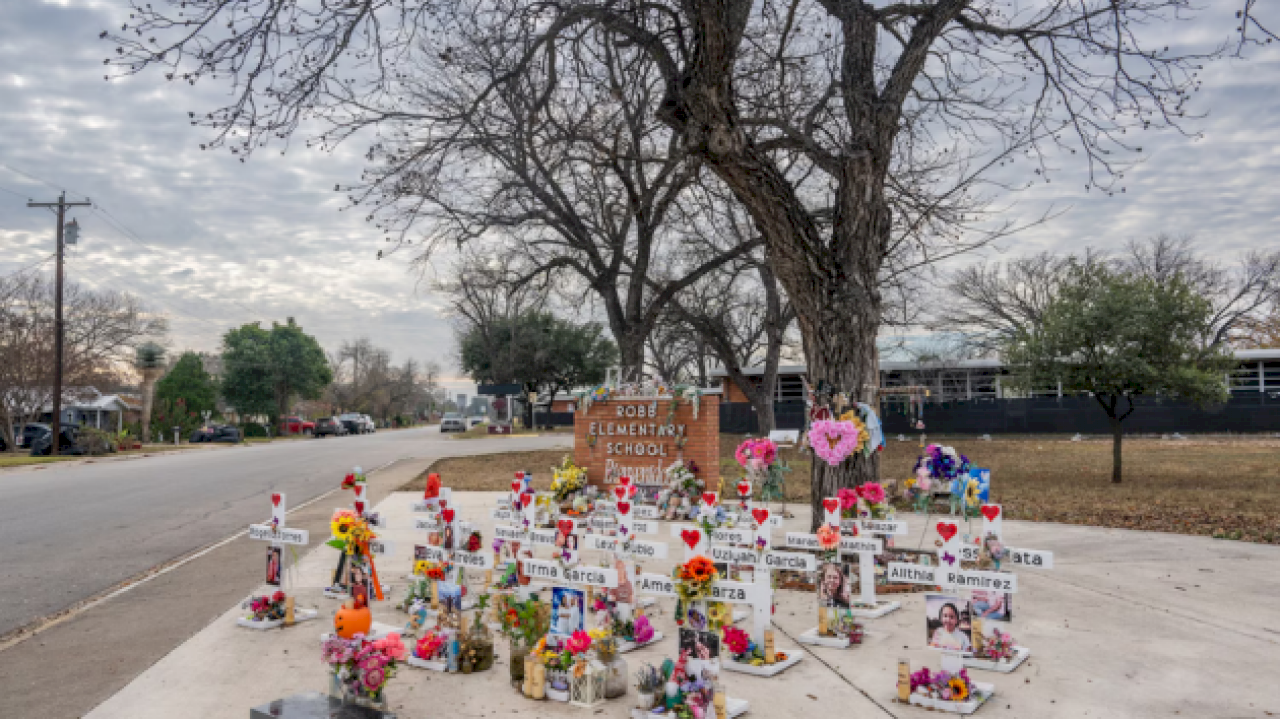
(UVALDE, Texas) — An attorney for former Uvalde, Texas, school police officer Adrian Gonzales brought a neon orange foam handgun to court on Monday as he tried to defend the police response to the Robb Elementary School mass shooting.
After stepping behind an eight-foot foam board, defense attorney Nico LaHood began his cross examination by asking the witness, a ranger with the Texas Department of Public Safety, “I’m going to point this — do you mind if I point this at you?”
LaHood proceeded to peek his fake weapon out of the foam board while asking the witness, Scott Swick, about the appropriate police response to a mass shooting.
“As a law enforcement officer, you should never rush into a situation without assessing it?” LaHood asked.
“To a point,” Swick said.
Prosecutors allege Gonzales, who is charged with child endangerment, did not follow his training and endangered the 19 students who died and an additional 10 surviving students. Gonzales has pleaded not guilty and his lawyers argue he is being unfairly blamed for a broader law-enforcement failure that day. It took 77 minutes before law enforcement mounted a counterassault to end the May 2022 rampage.
Another witness on Monday was Texas Ranger Terry Snyder, who testified about the shell casings recovered from the hallway of Robb Elementary.
During cross examination, defense attorney Gary Hillier tried to use the testimony to highlight the risk potentially faced by Gonzales.
“Because we’ve seen evidence here that rounds have been fired in this hallway, so anyone who enters through that doorway is entering a potentially life or death situation for them personally?” Hillier asked.
“Correct,” Snyder said.
Prosecutors attempted to recover from the cross examinations by highlighting the urgency of the police response to a mass shooting.
“So, when an officer hears shooting but can’t see shooting, what does the officer do?” prosecutor Bill Turner said.
“Runs to the shooting, where we tactically approach to where the shooting has occurred,” Snyder said.
Monday’s testimony was much more technical than last week’s, when the prosecution’s witnesses included educators who survived the massacre. Teacher Lynn Deming testified that she used her body to protect her fourth-grade students from gunfire and tried to keep them calm.
“I just kept saying, you know, like, ‘Babies, I love you. Just pray, I love you, OK,'” she testified as she held back tears. “I just wanted the last thing they heard was that somebody loved them. So, I think I said it a million times.”
Friday also brought the first testimony from a parent of a victim. Jennifer Garcia, whose 9-year-old daughter Eliahna Amyah Garcia was killed, told jurors, “We couldn’t find her. Kids were just running everywhere.”
According to former acting Dallas District Attorney Messina Madson, prosecutors appeared to be using their first witnesses to lay bare the tragedy that took place before turning their focus to Gonzales specifically.
“This is an unusual way to apply this law, and so from an overall point of view of what the district attorney’s office is trying to do is say this is a tragedy,” Madson, now a criminal defense attorney at MC Criminal Law, told ABC News. “This is a terrible, horrible thing that happened, and it is so horrible that not only do we have to mourn it, but somebody is criminally responsible, besides the person who pulled the trigger.”
According to Madson, prosecutors will need to clearly identify what opportunities Gonzales had to intervene and how close he was to the shooter to prove he “intentionally, knowingly, recklessly and with criminal negligence” placed students in harm’s way.
“It’s saying that somebody in those circumstances would have understood the risk and would have intervened and … you behaved in a way that was not how a reasonable person would in that situation,” Madson said.
ABC News’ Juan Renteria contributed to this report.
Copyright © 2026, ABC Audio. All rights reserved.

Top popular

Ingram man charged with murder after fatal shooting

Kerr Crime Stoppers offering reward up to $5,000 for information in last week’s non-viable school threat

KISD asks parents to communicate with children about words and actions after ‘copy cat’ threat note found at middle school

City of Kerrville Parks and Recreation reminds citizens that a Red Flag Warning is in effect until further notice

City of Kerrville says that May 7 General and Special Elections will proceed