Listeners:
Top listeners:
-
 play_arrow
94.3 Rev-FM The Rock of Texas | Where Texas Rocks
-
 play_arrow
99.1 The Buck Texas Country's Number 1 Country
-
 play_arrow
103.7 MikeFM Your Texas Hill Country Mix Tape
-
play_arrow
KERV 1230 AM
-
 play_arrow
JAM Sports 1 JAM Broadcasting Sports 1
-
play_arrow
JAM Sports 2 JAM Broadcasting Sports 2


What longstanding legal precedent says about birthright citizenship and the process to restrict it: Analysis
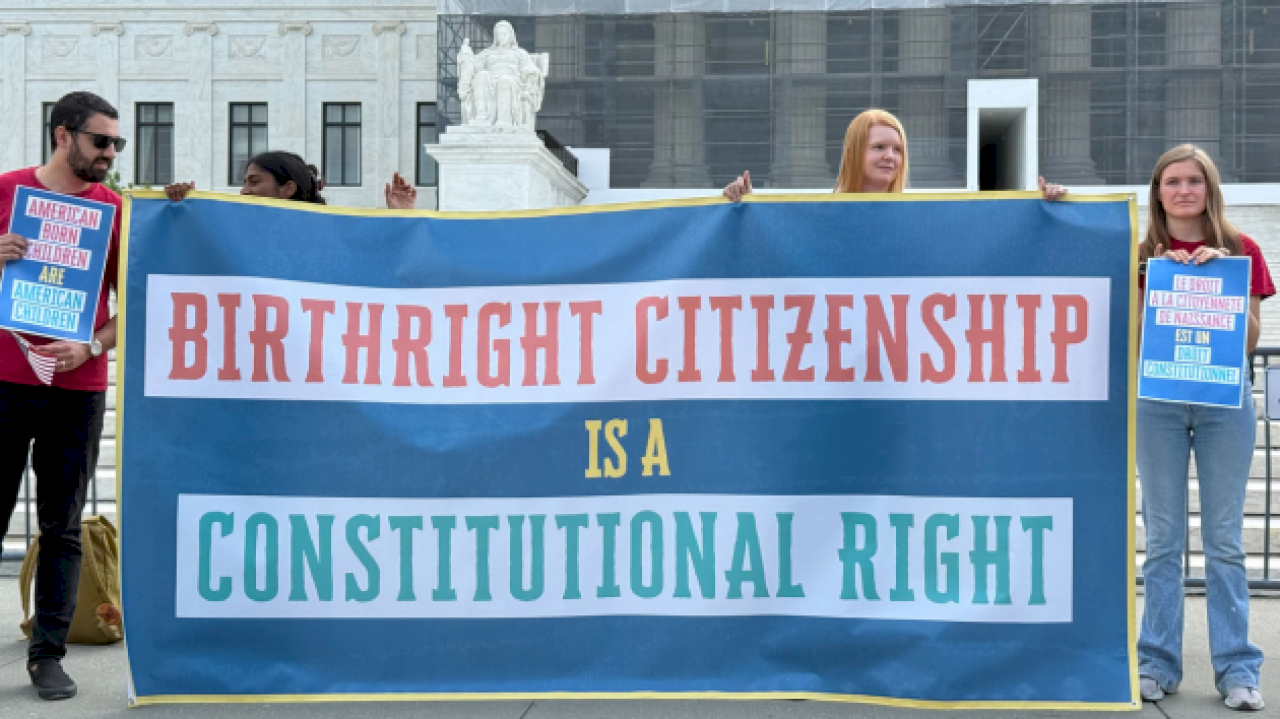
(NEW YORK) — When the Supreme Court agreed to hear the Trump administration’s petitions seeking to resurrect Executive Order 14160 — the president’s sweeping attempt to gut the Fourteenth Amendment’s guarantee of birthright citizenship — it effectively placed one of the Constitution’s most settled commitments on the docket.
The administration frames the dispute as a long-overdue “correction” to an overly generous citizenship regime, but the legal reality is far clearer: the executive order is an impossible fit with the text, history, and precedent surrounding the Citizenship Clause.
The path to revising that clause is laid out plainly in the document itself — not through executive decree, but through the arduous process of amending the Constitution. Those seeking to restrict birthright citizenship are free to attempt that route. What they cannot do is act as though a presidential signature can silently rewrite the Fourteenth Amendment.
As far back as Justice Samuel Chase’s statement during a 1798 oral argument, it has been settled that “the President has nothing to do with the proposition, or adoption, of amendments to the Constitution.”
The constitutional text and its historical foundations
The core constitutional question is straightforward: does the Fourteenth Amendment mandate birthright citizenship for all persons born on U.S. soil, regardless of their parents’ immigration status? Since ratification in 1868, the answer has been yes. The Citizenship Clause provides that “all persons born or naturalized in the United States, and subject to the jurisdiction thereof, are citizens of the United States.” The text is simple, unconditional, and deliberately broad. For more than a century, the Supreme Court has interpreted it to mean exactly what it says: if you are born in the U.S. and subject to U.S. law, you are a citizen.
The principles underlying that guarantee emerged long before Reconstruction. The doctrine of “jus soli” — citizenship based on birthplace — was deeply rooted in English common law and adopted by the original U.S. states. But early America also struggled with exclusions, most notoriously the Dred Scott decision, which in 1857 held that Black Americans could never be citizens. The Fourteenth Amendment, ratified 11 years later, was drafted to repudiate that decision and to prevent the creation of a hereditary class of noncitizens within the United States.
Congress later affirmed this constitutional commitment, passing statutes in 1940 and again in 1952 that aligned fully with the Amendment’s broad guarantee. For 150 years, administrations of both parties have understood birthright citizenship as a constitutional mandate, not an executive policy choice.
Wong Kim Ark and the settled rule of jus soli
The Trump administration’s legal theory hinges on the claim that the phrase “subject to the jurisdiction” excludes the U.S.-born children of undocumented immigrants and temporary visa holders. But that argument has been rejected for more than a century. In 1898, the Supreme Court in United States v. Wong Kim Ark held that the Fourteenth Amendment codified the long-standing common-law rule of jus soli. The only exceptions recognized at the time, and today, involve individuals genuinely outside U.S. legal authority, such as foreign diplomats and children born on foreign warships.
Immigration status has never been among those exceptions. That is because undocumented immigrants, like all other noncitizens living in the United States, are fully subject to U.S. law. They pay taxes, work, attend school, and remain subject to arrest, prosecution and removal. The government’s ability to enforce immigration law against them is itself proof that they are “subject to the jurisdiction” of the United States.
As professor Gerald Neuman, an immigration and nationality law expert at Harvard Law, has observed, the administration’s interpretation of birthright citizenship is not merely mistaken but “either a crazy theory or a dishonest interpretation of the Constitution.” The executive order ignores every relevant interpretive source — text, precedent and longstanding practice — and replaces them with a theory the Supreme Court foreclosed over a century ago.
The executive order’s constitutional and structural defects
Executive Order 14160 not only contradicts well-settled Fourteenth Amendment doctrine, it also appears to violate basic separation of powers principles. Citizenship rules are fixed in the Constitution and may be altered only through the amendment process. No president may redefine constitutional citizenship by unilateral directive. Yet that is precisely what Executive Order 14160 attempts to do, by conditioning birthright citizenship on the immigration status of a child’s parents.
While the administration claims the order would apply only prospectively, the constitutional problem is the same: the president lacks authority to alter constitutional meaning, even for future cases. The Fourteenth Amendment was designed to settle the rules of national membership beyond the reach of ordinary politics. Allowing the president to unilaterally revise those rules would collapse the distinction between constitutional law and executive preference.
Federal courts recognized these defects immediately. Within days of the order’s issuance, a district court temporarily blocked its implementation. The Supreme Court’s review thus raises not only the question of who qualifies as a citizen, but also whether constitutional guarantees can be rewritten by a single stroke of the executive’s pen.
James Sample is an ABC News legal contributor and a constitutional law professor at Hofstra University. The views expressed in this story do not necessarily reflect those of ABC News or The Walt Disney Company.
Copyright © 2025, ABC Audio. All rights reserved.


Top popular

Ingram man charged with murder after fatal shooting

Kerr Crime Stoppers offering reward up to $5,000 for information in last week’s non-viable school threat

KISD asks parents to communicate with children about words and actions after ‘copy cat’ threat note found at middle school

City of Kerrville Parks and Recreation reminds citizens that a Red Flag Warning is in effect until further notice

City of Kerrville says that May 7 General and Special Elections will proceed